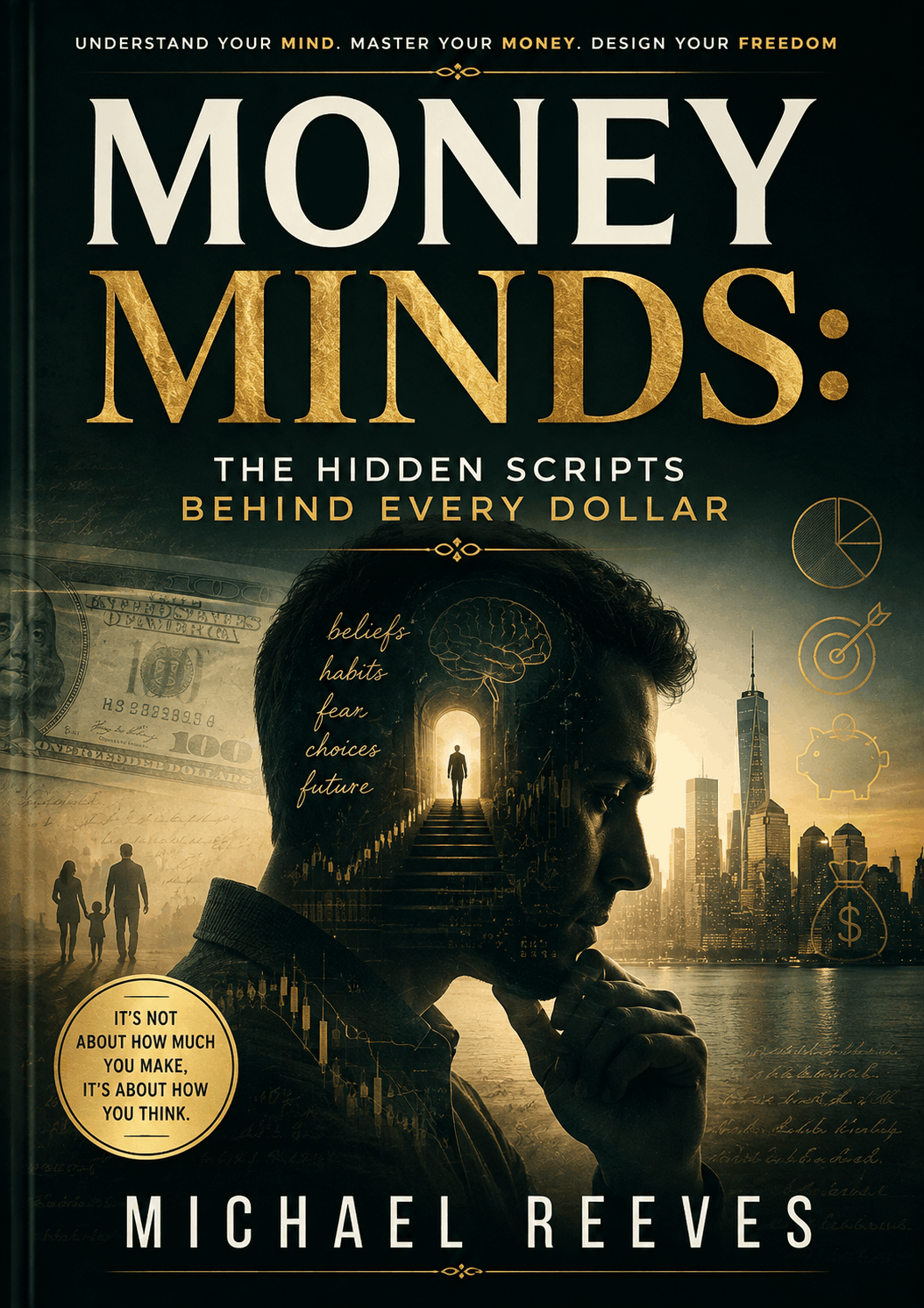
Money Minds: The Hidden Scripts Behind Every Dollar book cover
Premium Reader
AI Generated Book Finance 2026 39 reads 0.0 rating 0 favorites

Money Minds: The Hidden Scripts Behind Every Dollar

Written by Michael Reeves in a clean reading layout with chapter search, quick navigation, adjustable text size, and PDF export.

3
Chapters
1,591
Words
Aug 29, 2026
Published
About this book

Money Minds: The Hidden Scripts Behind Every Dollar

Summary

Explore the hidden psychology behind the way people earn, spend, save, invest, and think about money. This book examines how emotions, habits, fear, confidence, social pressure, and personal experiences influence financial decisions. Through relatable examples and practical insights, readers will learn how to develop healthier money habits, avoid common financial mistakes, and build a more thoughtful approach to wealth and financial freedom.

Unlock the unseen forces that steer every dollar you earn, spend, save, or invest—your hidden money scripts. In this cinematic journey through the psychology of finance, you’ll discover how childhood beliefs, emotions, and social pressures shape your financial destiny, and learn proven, actionable strategies to rewrite those scripts for lasting wealth and freedom.

Hidden, often contradictory money scripts drive irrational financial decisions, creating a tug‑of‑war between desire, fear, and societal expectations that keeps readers stuck in cycles of overspending, avoidance, or anxiety.

The contemporary financial landscape of everyday life—home budgets, workplace earnings, digital banking, and the social media arena where money narratives are constantly formed and reinforced.

Who it is for

Written for general readers. Genre: Finance. Tone: cinematic. Ending style: satisfying ending.

Chapter outline

  1. 1 The Echoes of Money: Unmasking Hidden Scripts
  2. 2 Origins of the Inner Ledger: Childhood Beliefs and Financial Fate
  3. 3 Rewriting the Script: From Fear to Financial Freedom

Key takeaways

  • Expose the core money scripts—avoidance, anxiety, status, power, and comfort—and how they manifest in daily choices.
  • Trace the origin stories of these scripts through family history, cultural messages, and personal experiences.
  • Provide a step‑by‑step framework for recognizing, challenging, and rewriting each script.
  • Translate script work into concrete financial tools: budgeting, debt snowball, investing basics, and habit stacking.
  • Showcase real‑life case studies that illustrate transformation from script‑bound to script‑free financial living.
  • Guide readers to craft their own empowering money narrative, delivering a satisfying sense of mastery and freedom.
  • The Reader – the everyday person seeking financial clarity
  • The Inner Money Script – the unconscious belief system guiding financial choices

FAQ

What is Money Minds: The Hidden Scripts Behind Every Dollar about?

Explore the hidden psychology behind the way people earn, spend, save, invest, and think about money. This book examines how emotions, habits, fear, confidence, social pressure, and personal experiences influence financial decisions. Through relatable examples and practical insights, readers will learn how to develop healthier money habits, avoid common financial mistakes, and build a more thought

Who should read this book?

Written for general readers. Genre: Finance. Tone: cinematic. Ending style: satisfying ending.

How is the book organized?

It has 3 chapters, including: The Echoes of Money: Unmasking Hidden Scripts; Origins of the Inner Ledger: Childhood Beliefs and Financial Fate; Rewriting the Script: From Fear to Financial Freedom.

How long is the manuscript?

About 1,591 words, by Michael Reeves.

No chapters found

Try another keyword or clear the search box.

1
Chapter 1

The Echoes of Money: Unmasking Hidden Scripts

In the vast and complex landscape of personal finance, there exists a hidden force that shapes our decisions and dictates our relationship with money. This force is known as our "money script," a term coined by financial psychologist Dr. Brad Klontz. Our money script is the culmination of our experiences, beliefs, and values regarding money, often formed in childhood and influenced by our environment and the people around us. It is the unconscious narrative that drives our financial behaviors, sometimes leading us down a path of irrational decisions and cycles of overspending, avoidance, or anxiety.

The journey to understanding and rewriting our money scripts begins with recognition. We must first become aware of the scripts that are currently driving our financial choices. For some, this may involve confronting a "Money Avoidance" script, where money is viewed as dirty or morally corrupt. This script can lead individuals to feel guilty about acquiring wealth or to avoid dealing with their finances altogether. Others may struggle with a "Money Anxiety" script, where the fear of not having enough money dominates their financial decisions, leading to stress and anxiety.

To illustrate the concept of money scripts, let's consider the story of Sarah, a successful business owner who despite her financial success, struggles with feelings of guilt and anxiety about her wealth. Her money script is rooted in her childhood, where her parents constantly argued about money, leading her to believe that wealth is a source of stress and conflict. As a result, Sarah finds herself avoiding financial discussions and decisions, fearing that she will never have enough.

The Financial Coach, a guide who translates psychology into practical money habits, plays a crucial role in helping individuals like Sarah recognize and challenge their money scripts. By providing a step-by-step framework for identifying and rewriting these scripts, the Financial Coach empowers readers to take control of their financial lives and make conscious, informed decisions about their money.

As we delve deeper into the world of money scripts, we will explore the various types of scripts that exist, including avoidance, anxiety, status, power, and comfort. We will also examine the origin stories of these scripts, tracing them back to family history, cultural messages, and personal experiences. By understanding the root causes of our money scripts, we can begin to challenge and rewrite them, paving the way for a healthier, more empowering relationship with money.

The Storyteller, through real-world examples and case studies, will illustrate the transformation that occurs when individuals rewrite their money scripts. We will see how people like Sarah, who once felt trapped by their financial beliefs, can break free and achieve financial freedom. The journey will not be easy, but with the right guidance and support, anyone can learn to recognize, challenge, and rewrite their money scripts, unlocking a more fulfilling and prosperous financial future.

In the next chapter, we will explore the origins of our inner money scripts, delving into the family histories, cultural messages, and personal experiences that shape our financial beliefs. We will examine how these scripts are formed and how they influence our financial decisions, often in ways that are detrimental to our well-being. By understanding the root causes of our money scripts, we can begin to challenge and rewrite them, paving the way for a brighter financial future.

2
Chapter 2

Origins of the Inner Ledger: Childhood Beliefs and Financial Fate

Our money scripts are formed in childhood, shaped by the experiences, beliefs, and values of our family and environment. The way our parents and grandparents thought about money, the financial flashpoints we experienced growing up, and the cultural messages we received all contribute to the formation of our inner money script. These early influences can have a profound impact on our financial decisions, often leading us down a path of irrational choices and cycles of overspending, avoidance, or anxiety.

For example, consider the story of Jack, who grew up in a household where money was always scarce. His parents constantly argued about finances, and he often went without the things he wanted. As a result, Jack developed a "Money Anxiety" script, where he believes that he will never have enough money. This script drives his financial decisions, leading him to overspend and accumulate debt in an attempt to alleviate his anxiety.

The Financial Coach recognizes that Jack's money script is rooted in his childhood experiences and works with him to identify and challenge these beliefs. By providing a framework for recognizing and rewriting his money script, the Financial Coach empowers Jack to take control of his financial life and make conscious, informed decisions about his money.

As we explore the origins of our inner money scripts, we will examine the various ways in which family history, cultural messages, and personal experiences shape our financial beliefs. We will see how these early influences can lead to the formation of different types of money scripts, including avoidance, anxiety, status, power, and comfort. By understanding the root causes of our money scripts, we can begin to challenge and rewrite them, paving the way for a healthier, more empowering relationship with money.

The Storyteller will illustrate the transformation that occurs when individuals rewrite their money scripts. We will see how people like Jack, who once felt trapped by their financial beliefs, can break free and achieve financial freedom. The journey will not be easy, but with the right guidance and support, anyone can learn to recognize, challenge, and rewrite their money scripts, unlocking a more fulfilling and prosperous financial future.

As we continue on this journey, we will explore the various tools and strategies that can help us rewrite our money scripts. We will examine the importance of budgeting, debt management, and investing, and how these tools can help us achieve financial freedom. We will also discuss the role of habit stacking, where we build new financial habits on top of existing ones, leading to lasting change and a more empowering relationship with money.

In the next chapter, we will explore the process of rewriting our money scripts, providing a step-by-step framework for recognizing, challenging, and rewriting these scripts. We will examine the various strategies and tools that can help us achieve financial freedom, including budgeting, debt management, and investing. By providing a clear and actionable plan, we will empower readers to take control of their financial lives and achieve a brighter financial future.

3
Chapter 3

Rewriting the Script: From Fear to Financial Freedom

Rewriting our money scripts requires a deep understanding of the underlying beliefs and values that drive our financial decisions. It involves recognizing the patterns and habits that have been holding us back and replacing them with new, empowering beliefs and behaviors. This process can be challenging, but with the right guidance and support, anyone can learn to rewrite their money scripts and achieve financial freedom.

The first step in rewriting our money scripts is to recognize and challenge our current beliefs and values. This involves identifying the negative self-talk and self-sabotaging behaviors that have been holding us back and replacing them with positive, empowering affirmations. For example, if we have a "Money Avoidance" script, we may need to challenge our belief that money is dirty or morally corrupt. We may need to remind ourselves that money is simply a tool, a means to an end, and that it can be used to achieve our goals and dreams.

The Financial Coach plays a crucial role in this process, providing a step-by-step framework for recognizing, challenging, and rewriting our money scripts. By offering guidance and support, the Financial Coach empowers readers to take control of their financial lives and make conscious, informed decisions about their money.

As we rewrite our money scripts, we will also need to develop new financial habits and skills. This may involve learning about budgeting, debt management, and investing, and how to apply these tools in our daily lives. It may also involve building new habits, such as saving and investing, and replacing old habits, such as overspending and accumulating debt.

The Storyteller will illustrate the transformation that occurs when individuals rewrite their money scripts. We will see how people like Sarah and Jack, who once felt trapped by their financial beliefs, can break free and achieve financial freedom. The journey will not be easy, but with the right guidance and support, anyone can learn to recognize, challenge, and rewrite their money scripts, unlocking a more fulfilling and prosperous financial future.

As we conclude this journey, we will reflect on the importance of developing a healthy and empowering relationship with money. We will see how rewriting our money scripts can lead to financial freedom, and how this freedom can bring a sense of peace, security, and fulfillment to our lives. By providing a clear and actionable plan, we will empower readers to take control of their financial lives and achieve a brighter financial future.

In the end, rewriting our money scripts is a journey, not a destination. It requires patience, persistence, and practice, but the rewards are well worth the effort. By developing a healthy and empowering relationship with money, we can achieve financial freedom and live a more fulfilling and prosperous life. The Financial Coach, the Storyteller, and the Reader will all play a role in this journey, guiding and supporting each other as we work to rewrite our money scripts and achieve financial freedom.

Reader Reviews

Share quick feedback for Michael Reeves and help other readers decide what to read next.

0.0
0 reviews

No reviews yet. Be the first reader to share feedback.